Is ARC Raiders dead? The player decline and Frozen Trail’s October test
Steam activity is still falling. Here is what the numbers tell us, what they leave out, and what Frozen Trail needs to change.
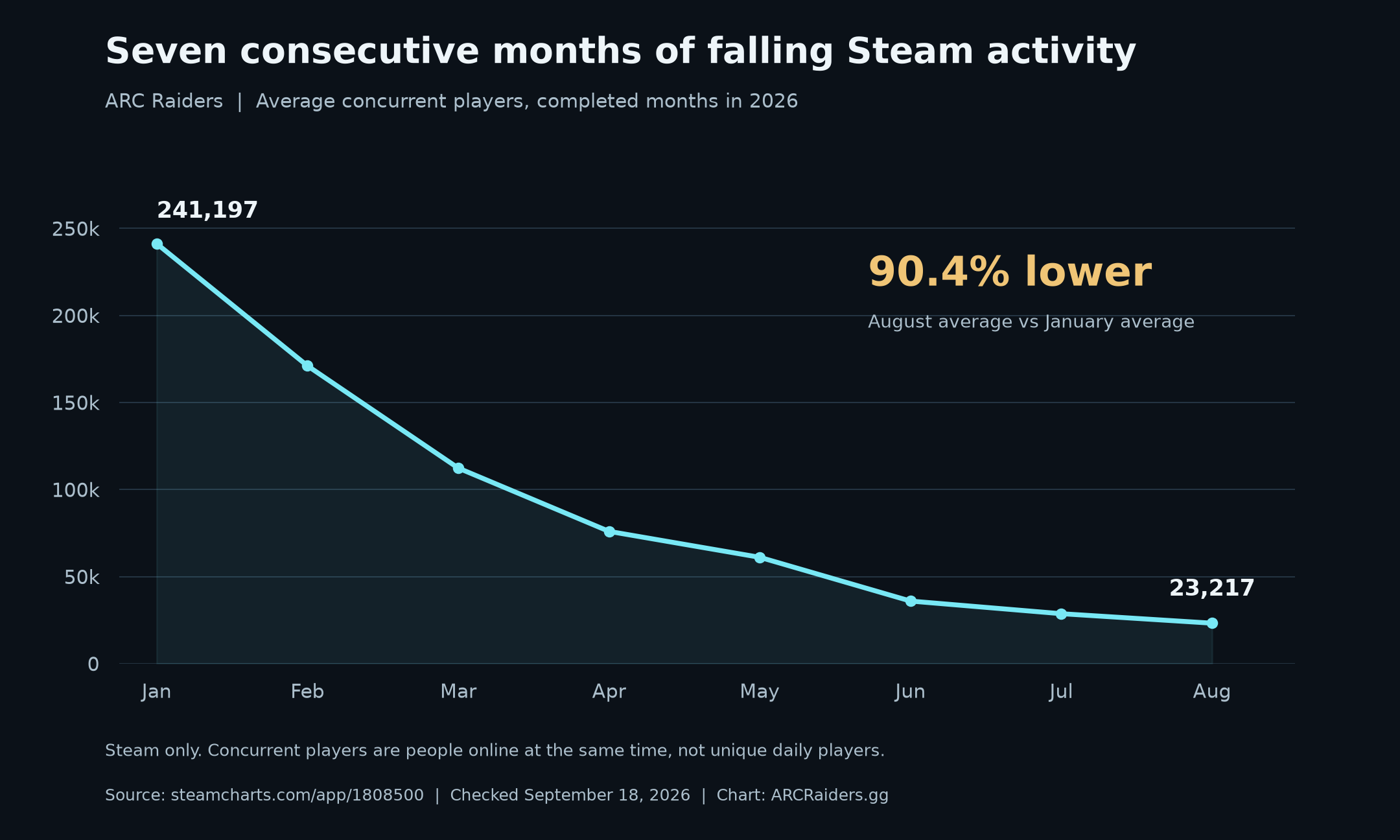
Is ARC Raiders dead? No. It still has an active audience and a major update on the way, but the Steam decline is too large to shrug off. Average concurrent players fell about 90.4% between January and August 2026, according to Steam Charts’ completed monthly figures. Frozen Trail arrives on October 8. Its harder job will be giving returning players a reason to stay after they have seen the new map.
Research checked September 18, 2026. Steam figures describe Steam activity. They do not count the whole cross-platform audience.
Key takeaways
- Steam activity fell for seven consecutive completed months, from February through August. The decline continued well beyond the launch rush.
- Recent Steam reviews are Mixed. That adds evidence of frustration, though reviewers are a self-selected group.
- Frozen Trail adds a map and progression changes. Those plans address reasons to return, but their effect on player activity is still unknown.
- The useful October comparison is sustained activity against a fixed pre-update baseline. A big release-day peak alone will leave the main question unanswered.
Is ARC Raiders dead in September 2026?
A shrinking game can still have enough people to support good matches. A game with a large worldwide audience can also feel empty in a particular region, at a particular hour, or in a specific queue. “Dead” collapses those different experiences into one word.
For this assessment, the questions are whether people are still playing, whether support is continuing, and whether there is evidence that activity is stabilising. The first two have clear supporting evidence. The third remains a problem.
SteamDB recorded a 24-hour Steam peak of 26,458 when checked for this article. Embark has announced a substantial October update. That supports calling ARC Raiders active. It does not tell us whether every player gets a quick, well-matched lobby.
There is no verified, current all-platform daily player total in the sources reviewed here. Console players matter, and leaving them out understates the audience. Adding a guessed console multiplier would create a number we cannot defend.
The Steam player trend is the strongest reason for concern
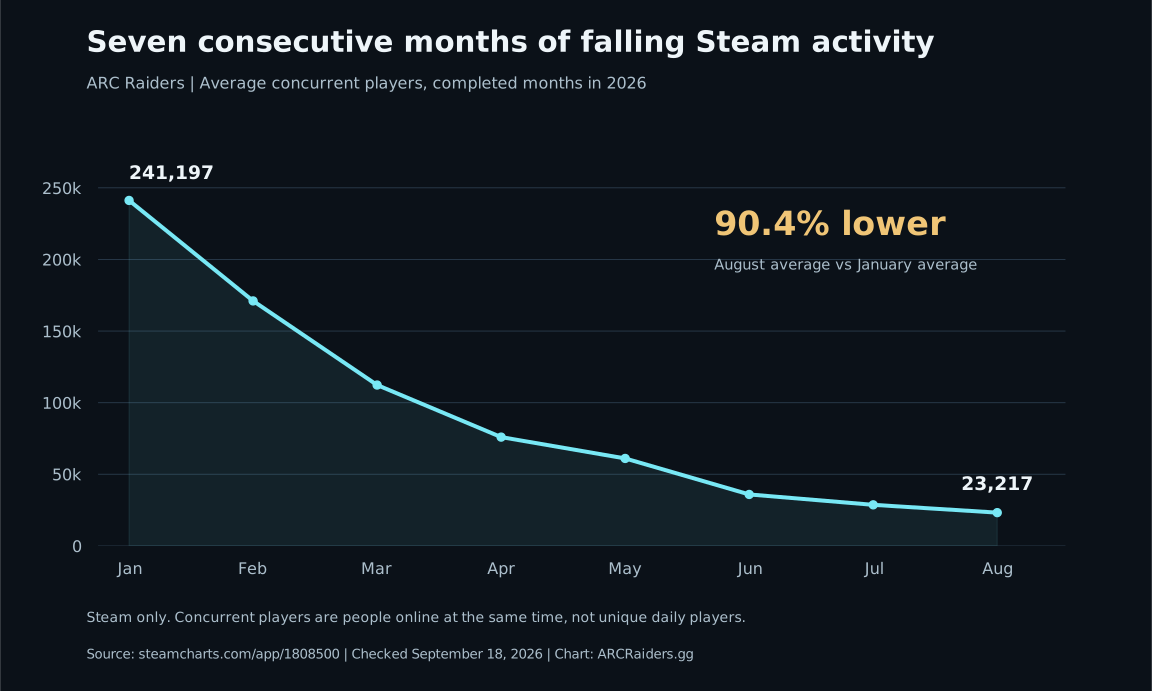
Monthly averages are more useful here than a screenshot of whoever happens to be online. They smooth out the difference between a quiet weekday morning and a busy weekend evening.

Download the chart as PNG · Get the SVG · Download the monthly data as CSV
| Month in 2026 | Average concurrent Steam players | Monthly change |
|---|---|---|
| January | 241,197 | +5.15% |
| February | 171,037 | −29.09% |
| March | 112,312 | −34.33% |
| April | 75,952 | −32.37% |
| May | 61,054 | −19.62% |
| June | 35,915 | −41.17% |
| July | 28,662 | −20.20% |
| August | 23,217 | −19.00% |
The shape matters as much as the size of the fall. This is a sequence of lower months, with another substantial drop in August. Describing all of it as the end of launch hype skips the question of when the decline stops.
It would also be wrong to say that this measures the percentage of people who quit. Concurrent players are people online at the same time. Fewer active players, shorter sessions, or fewer sessions can all pull the average down. Public concurrency data cannot separate those effects.
Why do player-count sites show different numbers?
The headline records do not agree. Steam Charts lists an all-time peak of 465,097; SteamDB lists 481,966. Tracker Network’s monthly table also includes 481,966, while its headline record showed a different figure during research.
We have kept the monthly chart on one provider’s series. Tracker’s January and August averages independently give roughly the same 90.4% fall, but both trackers are measuring Steam. That cross-check cannot fill the console gap.
The provider comparison CSV records those disagreements. Mixing one site’s record peak with another site’s current count can make a dramatic graphic, but it produces a different comparison from the monthly trend shown here.
What reviews and developer interviews add
The English Steam storefront showed 49% positive feedback from 2,603 recent reviews when checked, labelled Mixed. Its lifetime English review score was 81% positive from 199,381 reviews.
Those figures point to a more frustrated recent group of reviewers. They do not establish that half the audience dislikes the game, and the recent and lifetime review groups should not be treated as a controlled survey. People choose whether to leave a review.
There is a more direct account of the content problem. In GamesBeat’s interview with executive producer Aleksander Grøndal, he said “the team just couldn’t keep pace with the players”. The interview describes a move towards larger updates and longer-term progression work.
Embark had already identified the issue in its May development update. Experienced players were reaching progression limits, filling their storage, and running short of uses for their accumulated loot. The studio moved from monthly major updates to two larger updates a year, with smaller changes continuing between them.
That explanation fits a game whose most committed players have consumed much of what it offers. It does not prove why each person left. The Steam decline was underway before the May announcement, so blaming the entire fall on the new update schedule would get the order of events wrong.
Lifetime sales answer a different question
Nexon’s Q2 2026 investor presentation, slide 3, reported more than 16.3 million cumulative units sold and ¥18.3 billion in ARC Raiders revenue for that quarter. This is the publisher’s presentation, hosted by InvestGame.
That is evidence of substantial commercial success. Copies sold since launch do not tell us how many owners still play in September, and quarterly revenue cannot settle whether tonight’s matches will feel healthy. Both the sales success and the current decline can be true.
What YouTube and Reddit tell us, and where they stop
In his September 8 update video, around 0:54, JxShepp describes his own fatigue with ARC Raiders while acknowledging that plenty of people still play. He worries about competition for players’ time in October and asks, “Is it going to be enough content to keep players interested?” His question is whether Frozen Trail can hold that interest after bringing people back.
Later, around 9:28, he explains that concerns about the game have reduced his motivation to make ARC Raiders videos. That is a useful account of one creator’s fatigue. It cannot tell us how common that feeling is across the audience, but it gives the October update a concrete test: can it make someone who already cares about the game want to spend more time with it?
Loochy’s June “Is ARC Raiders actually dead?” livestream and July “So ARC Raiders is actually dead...” livestream show that the question was circulating earlier. We reviewed their titles and descriptions only. Their discussions are not used as evidence for either verdict.
Reddit turns the broad argument into more useful questions. One thread about the falling player count asks what it could mean for matching solo players with teams. A September discussion about a possible comeback asks whether the next big update will bring people back.
The replies are useful accounts of what individual players care about. They are not a representative sample. A thread full of people planning to return cannot predict a return rate; a thread full of complaints cannot measure the whole community’s mood.
For someone deciding whether to play tonight, a global chart has limits. Region, local time, party size, queue duration, and how often a match starts late would make a much better account of that player’s experience. The public sources reviewed here do not provide that breakdown.
What the decline could mean for Frozen Trail
Frozen Trail is scheduled for October 8, with a mountainous winter map, new ARC enemies, and a high-level ARC Operation. Embark has also announced the Outpost, with decoration, research and progression, plus skill-tree and Raider Deck changes.
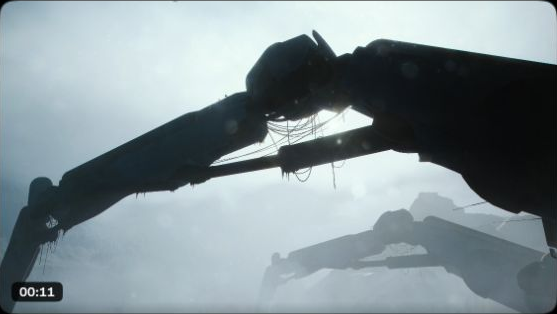
What does the Frozen Trail teaser show?
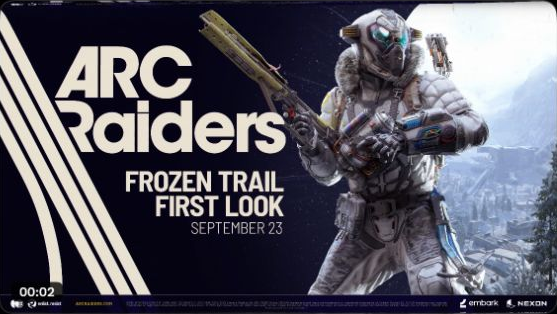
Embark’s September 18 teaser announces a Frozen Trail First Look on September 23 at 1 p.m. EDT, 10 a.m. PDT or 7 p.m. CEST. That is the preview date. The update still arrives on October 8.
Download the map screenshot · Download the first-look card
The footage gives players something concrete to examine while they wait. It doesn't establish which machines are active enemies, how their fights work, or how long the new progression will last. Those details matter more to the comeback argument than the size of a machine in a teaser.
Our coverage of Embark’s May development update explains the original Frozen Trail announcement. For the player-count question, the connection between the planned additions matters more than the length of the feature list.
The Outpost needs to give repeated raids a purpose
A new map can provide a strong reason to reinstall. Research and progression could give the loot brought home a lasting use. If those systems offer worthwhile decisions after the first few sessions, they would address the progression ceiling Embark described in May.
That is the case for optimism. The unknown is how long the new goals remain interesting, especially for players who reached the old limits quickly. We cannot judge that from an announcement.
Grøndal’s PCGamesN interview about Frozen Trail discusses progression systems feeding back into one another and the challenge of bringing players back. The plan points towards a longer loop between raids. Whether it works will depend on the shipped rewards, pacing, and reasons to keep making trips.
A return spike would create an opportunity to rebuild trust
Returning players will encounter the live game, with its matchmaking, stability, and cheating problems or improvements. Fresh content can get them through the door. Their sessions will determine whether they keep playing.
Embark says work on those systems continues. That is a commitment to work, not proof that the problems have been solved. October reviews and specific reports of match quality will help explain the activity numbers, provided they are kept separate from population measurements.
The Expedition pause changes the context
Embark’s fifth Expedition announcement says it will be the last departure before a planned overhaul, with the next Expedition expected in early 2027. Trials pause after September 22 and are due back with Frozen Trail.
The Expedition system’s future is still unsettled. PC Gamer reported on September 14 that Grøndal had told PCGamesN scrapping it altogether was also an option. Players should not assume the same reset system will return on a fixed schedule.
That matters when reading the September baseline. The weeks before October contain scheduled changes to reasons for logging in, rather than a perfectly steady version of the game. October activity will reflect the combined release and returning activities. A chart alone will not tell us how much each part contributed.
Before the update, the 1.45 patch notes and deadline guide cover the approaching Cred expiry. Players coming back now can also check the quest guide for existing objectives.
How to judge the October comeback
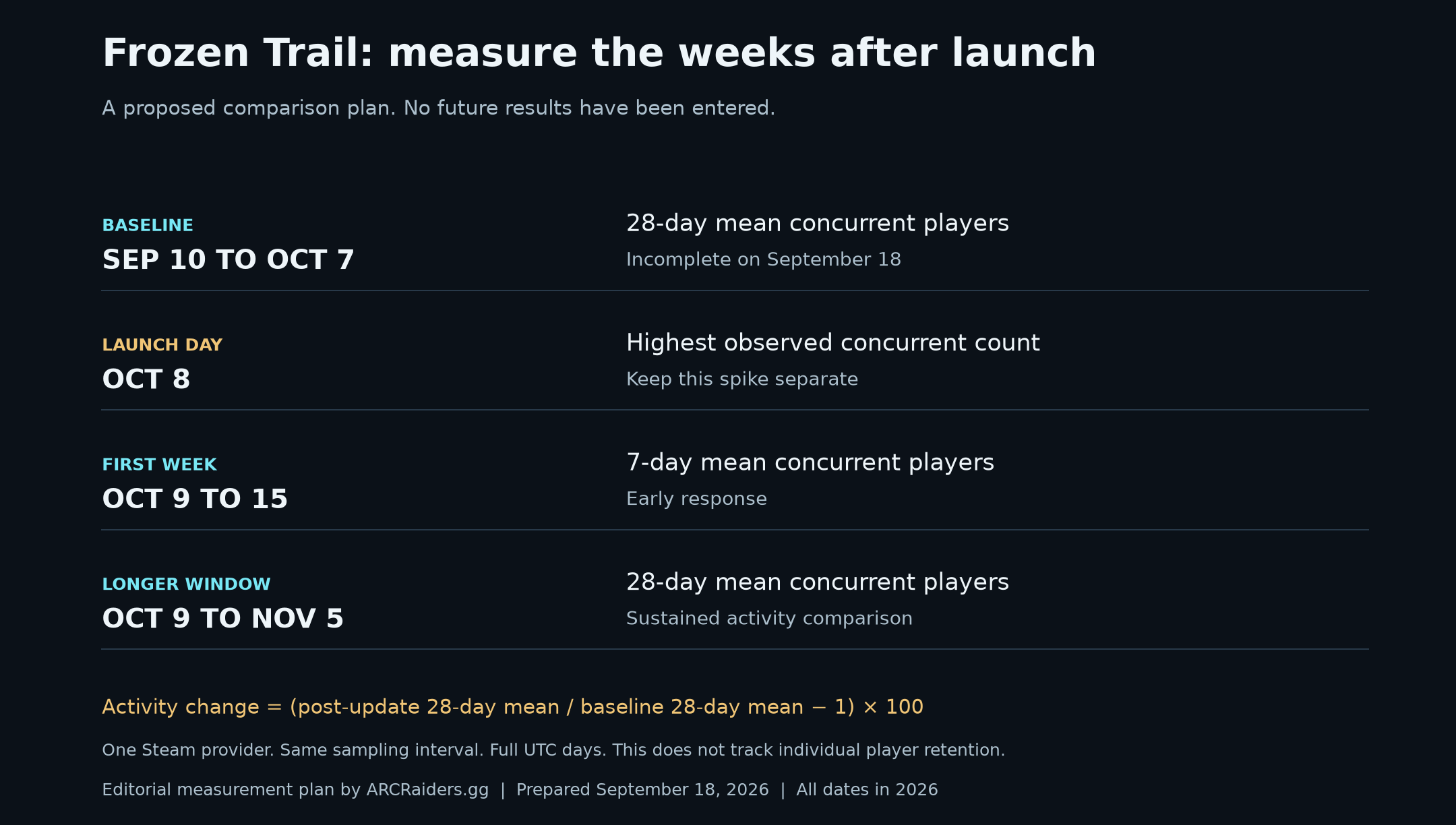
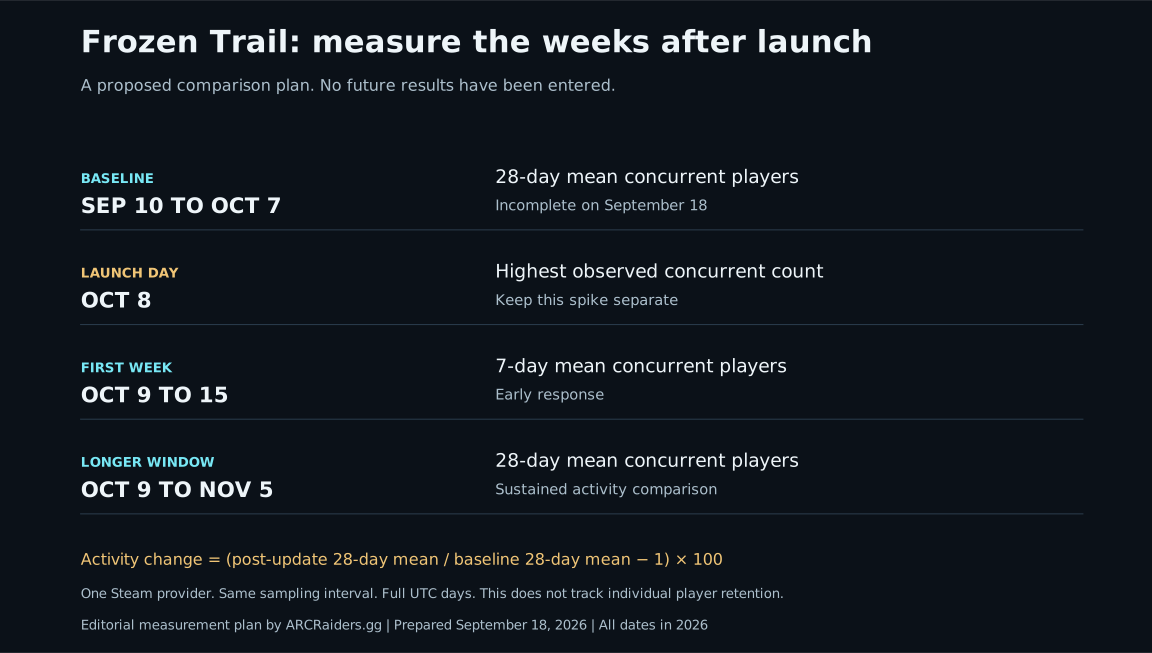
We propose a fixed comparison window so the verdict does not depend on whichever screenshot looks best. This is an editorial measurement plan. The future results are blank.

Download the scorecard PNG · Get the SVG · Get the blank measurement CSV
| Window, all dates in 2026 and UTC | What to record | What it can show |
|---|---|---|
| September 10 to October 7 | Mean concurrent Steam players across 28 days | The pre-update baseline, still incomplete at publication |
| October 8 | Highest observed concurrent Steam count that day | Launch-day attention, kept separate |
| October 9 to 15 | Mean concurrent Steam players across seven days | The first week after launch day |
| October 9 to November 5 | Mean concurrent Steam players across 28 days | Whether the initial lift holds across a longer window |
Use one provider, the same sampling interval, and full UTC days throughout. Both 28-day windows contain four of every weekday. Record missing coverage instead of treating missing observations as zero. The methodology explains the calculation and the data needed to fill the sheet.
The main comparison is straightforward: divide the post-launch 28-day average by the pre-update 28-day average, subtract one, and multiply by 100. That gives the percentage change in average concurrent activity. It cannot tell us what percentage of October’s returning players stayed, because that requires tracking the same people over time.
A sustained rise, improving recent reviews, and credible reports of better matches would support a recovery argument. A large October 8 peak followed by a return to the old baseline would be a much weaker result. Neither outcome needs to reach the launch record to be meaningful.
Frequently asked questions
Is ARC Raiders dead on console?
The sources reviewed here do not establish that. Steam statistics exclude console play, and we found no current, verified all-platform daily total or regional queue dataset. A Steam decline cannot be copied across every platform as an exact percentage.
Will Frozen Trail save ARC Raiders?
It could bring players back and give them longer-term goals. Its effect is unproven before release. The first week will show immediate interest; several weeks of sustained activity will provide a better test of its staying power.
Is it worth returning before October 8?
Return now if you still have objectives you want to finish or friends who want to play. If your reason for stopping was exhausted progression, waiting for the announced systems may make more sense. Check the deadlines linked above before leaving unspent Cred until the update.
Can I use the charts and data?
Yes. Download the original charts and CSVs linked above and credit ARCRaiders.gg and the named data provider. Keep the date, Steam-only scope, and source labels attached. Official Embark artwork and teaser screenshots have separate ownership and are not included in this permission.
Sources and methodology
This article combines public Steam trackers, platform reviews, developer announcements, original interviews, a publisher presentation, and selected community discussions. Figures were checked on September 18, 2026. Counts and review scores change over time.
The downloadable methodology includes calculations, coverage limits, image credits, and the distinction between observed data and the proposed October scorecard. JxShepp’s commentary was reviewed through a supplied transcript; the Loochy livestreams were checked for their titles and descriptions only. The research did not include a player survey, private console analytics, or direct matchmaking tests.
Our assessment is that ARC Raiders remains active and supported, with a persistent Steam decline that Frozen Trail has yet to reverse. If you return, share your region, usual play time, and match experience in the ARCRaiders.gg forums. That detail is more useful to another player than a screenshot captioned “dead game”.